Automatic battery sizing for peak shaving
Automatically calculate the required power and capacity for peak shaving. Stay within your contract capacity and get the most out of your available connection.
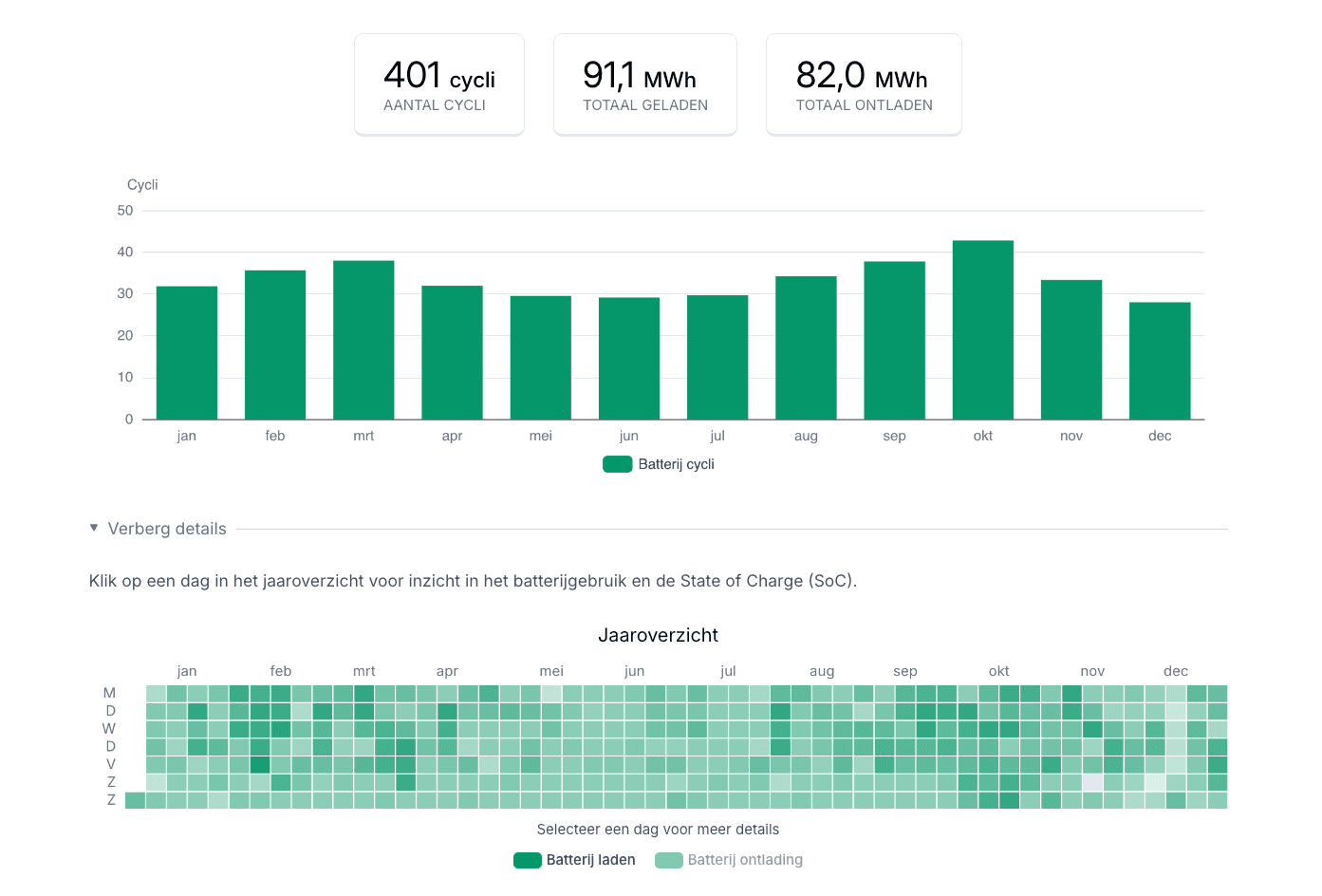
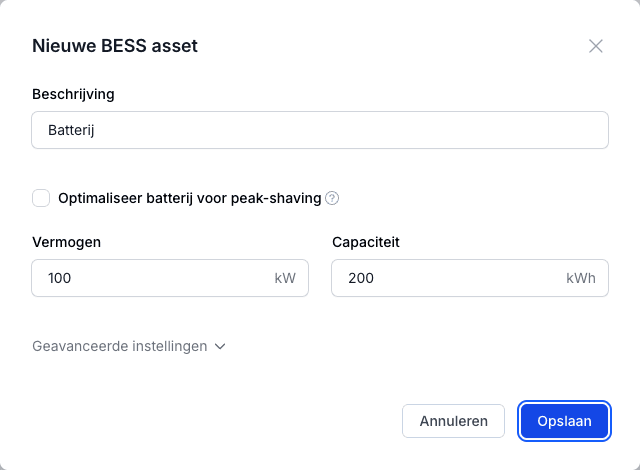
Automatic sizing
Calculate a suitable battery capacity and power for effective peak shaving without manual effort.
- Including round-trip efficiency
- Including depth of discharge
- And more configuration options
Respect grid constraints
Account for contract capacity and physical grid connections for realistic solutions.
- Contract capacity limits
- Flex contracts (CBC)
- Congestion management
Efficient analysis
From problem to solution in minutes. Ideal for quick quotes and feasibility studies.
- Fast calculation
- No manual iterations
- Repeatable results
How battery sizing works in Wattix
How large should a commercial battery for peak shaving be? Its power (kW) must cover at least the largest exceedance of the connection limit. Its capacity (kWh) follows from the largest shortfall that builds up before the battery can recharge under that limit, plus the discharge loss and charge limits. Only 15-minute data shows this reliably: hourly averages smooth the peaks away.
- What you put in
- The connection's 15-minute data and the profiles of what is there or being added: consumption, solar panels, charge points or a generator. Then the limits of the connection: the contracted transport capacity for import and export, and any capacity contracts with a different limit per hour. For the battery you set the round-trip efficiency and the charge limits, the minimum and maximum state of charge.
- What Wattix calculates
- Wattix simulates the whole period of your data in 15-minute steps and finds, in one optimisation, the smallest battery that keeps import and export within the limits. Power and capacity follow from the profile independently, so no standard sizes are tried. The sizing looks at the limits of the connection, not at energy prices: what the battery costs and earns, you compare in your scenarios afterwards.
- What comes out
- The required power in kW and capacity in kWh, the new import and export peaks, the number of days with an exceedance and the number of charge cycles. If no battery can solve every peak, you see the best feasible battery and how much exceedance remains.
Configure your energy system
Add consumption profiles, solar panels and other assets to your project

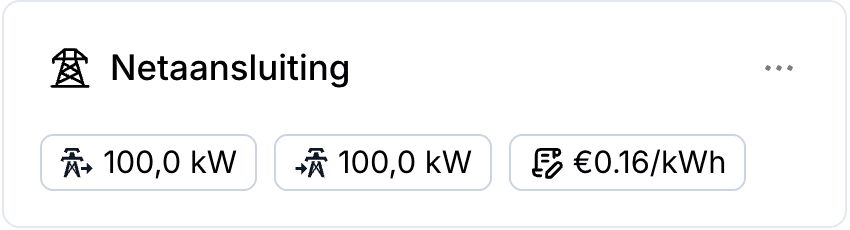
Define grid connection constraints
Set your contract capacity and physical grid connection limits
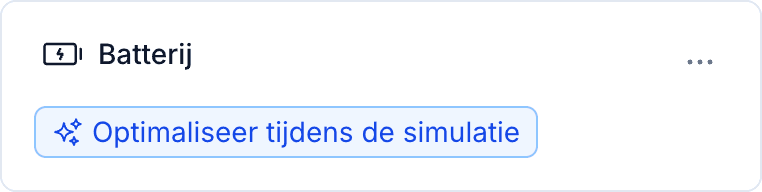
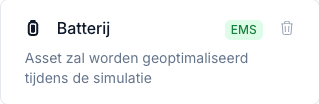
Activate automatic battery sizing
Let the algorithm calculate the optimal battery configuration
Analyze results and peak shaving effect
View the recommended battery specs and the effect on your power peaks
Essential for peak shaving projects
Battery sizing helps professionals quickly size energy storage for grid congestion
Industrial installations
Prevent contract capacity exceedance at factories and production sites
Office buildings
Manage peak load from HVAC systems and other building installations
Charging plazas
Buffer power peaks from fast chargers without grid expansion
Data centers
Manage peak consumption of server parks and cooling installations

“A cheese maker had three power outages in six months. A few hours of work in Wattix, a detailed report, and the customer, who had only wanted a battery, decided on the spot to add solar panels too. Without Wattix I would have been at it for weeks.”
Frequently asked questions about battery sizing
How do you determine the right battery capacity for a business?
From the connection's 15-minute data. The power has to absorb the largest exceedance of the limit, the capacity the largest amount of energy above that limit before the battery can recharge. Wattix works this out over the whole period of your data and returns the smallest battery that stays within the limits.
Why 15-minute data rather than hourly data?
Peaks often last less than an hour. Hourly averages hide them, so a battery sized on hourly data comes out too small. That is why Wattix always calculates in 15-minute steps and only works with 15-minute data as input.
What is peak shaving?
With peak shaving a battery covers the part of consumption that exceeds the connection limit, and recharges at quiet moments within that same limit. That lets a business use more than the connection allows at peak moments, without exceeding it. The same works for export peaks.
What is the difference between peak shaving and load shifting?
Peak shaving removes peaks with stored energy. Load shifting moves the consumption itself to another moment, such as a process or EV charging. To work through load shifting, you adjust the consumption profile and compare that scenario with one that has a battery.
What if no battery can solve every peak?
Then Wattix shows the best feasible battery, marked as an infeasible optimisation, and you see how much exceedance remains. That is an outcome too: you know a battery alone is not enough, and can work through a combination with, for example, a different contract.
When does a commercial battery pay off?
That depends on what the battery returns against the investment: avoided exceedances, lower transport costs from a lower monthly peak and room to expand. Wattix first sizes against the limits of the connection. You then compare scenarios with and without a battery on total energy costs.
Related pages
- Sizing a battery for a businessHow to calculate kW and kWh from quarter-hour data, with a worked example and what rules of thumb make of it.
- Behind-the-meter battery storageSize storage for peak shaving and for using more of the energy you generate.
- Wattix for installersSize systems in minutes and work through scenarios live with your client.
Quick and accurate battery sizing with Battery Sizing
From peak problem to battery solution in minutes. Ideal for installers and consultants who need to quickly determine which battery solves the grid congestion problem.
Schedule a demo