Sizing a battery for a business: how to calculate kW and kWh
How big should a business battery for peak shaving be? Calculate kW and kWh from quarter-hour data, with a worked example for a metalworking company.
The power (kW) of a peak-shaving battery must cover the largest exceedance of the contracted transport capacity. The capacity (kWh) follows from the largest shortfall that accumulates before the battery can recharge under the limit, plus discharge losses and charge limits. Use a year of quarter-hour data: hourly data underestimates the power, and rules of thumb are often off.
Power and capacity: two separate questions
A peak-shaving battery covers the part of consumption that rises above the contracted transport capacity. Think of the grid connection as a water pipe that is too narrow at the busiest moments, and the battery as a tank next to it that fills up when it is quiet and empties when it is busy. Then you have two things to choose: how far the tank's tap can open, and how much water it holds.
- Power (kW) sets how high a peak can be for the battery to still cover it. If it is too low, the battery does not fully cover the largest peak and its top still gets through.
- Capacity (kWh) sets how long the battery can keep that up. If it is too small, the battery runs empty halfway through the peak hours and consumption goes over the limit for the rest of them.
Both follow from the load profile, but independently. In the worked example below they even come from different days. That is why a fixed ratio between kWh and kW does not work.
Sizing a battery in four steps
- Take a year of quarter-hour data. In the Netherlands, the grid operator meters a large connection per quarter hour, and that is also what the contracted transport capacity is checked against. You need a full year because the heaviest days often fall in winter.
- Determine the power: the largest exceedance. Find the quarter hour with the highest consumption and subtract the contracted transport capacity. What is left is the battery's minimum power.
- Determine the capacity: the largest accumulated shortfall. Step through the year quarter hour by quarter hour. When consumption is above the limit, add up the energy above it. When it drops below, the battery may recharge, but only with the room left under the limit. The highest point this shortfall reaches in the whole year is the energy the battery has to deliver in one go.
- Add the discharge losses and charge limits. With a round-trip efficiency of 85%, about 8% is lost when discharging, so you divide by 0.92. And a battery is rarely used from 0 to 100%: if you charge between 10% and 100%, you divide by 0.9 as well. The loss when charging does not end up in the capacity, but in the time recharging takes.
Step 3 is exactly what the rules of thumb further down skip. It is not about the largest peak, not about the average peak, and not about the energy per day. It is about how much has to come out of the battery in one go before it can recharge. If there is enough room under the limit between two peaks, the battery starts the next one full again. If there is not, the shortfall builds up, sometimes over several days.
Worked example: a metalworking company with 300 kW of transport capacity
A metalworking company runs one shift on weekdays, from 7:00 to 16:00. It has machining equipment, presses, two compressors and a 90 kW electric oven for heat treatment, which runs for a few hours on about a third of working days. A heat pump heats the hall and preheats it on cold mornings. The company uses 735 MWh a year, 84 kW on average. Its contracted transport capacity is 300 kW, and a larger connection is not available for now, because the grid operator has a waiting list.
The company is an example. Its profile was built for this article quarter hour by quarter hour over all of 2025, with public holidays, a summer shutdown and cold and warm weeks. In that year, consumption goes above 300 kW on 84 days, in 582 quarter hours in total.
The power. The highest quarter hour falls on Tuesday 16 December at 10:45, when the oven switches on during a busy morning: 390 kW. That is 90 kW above the limit, so the battery must be able to deliver at least 90 kW.
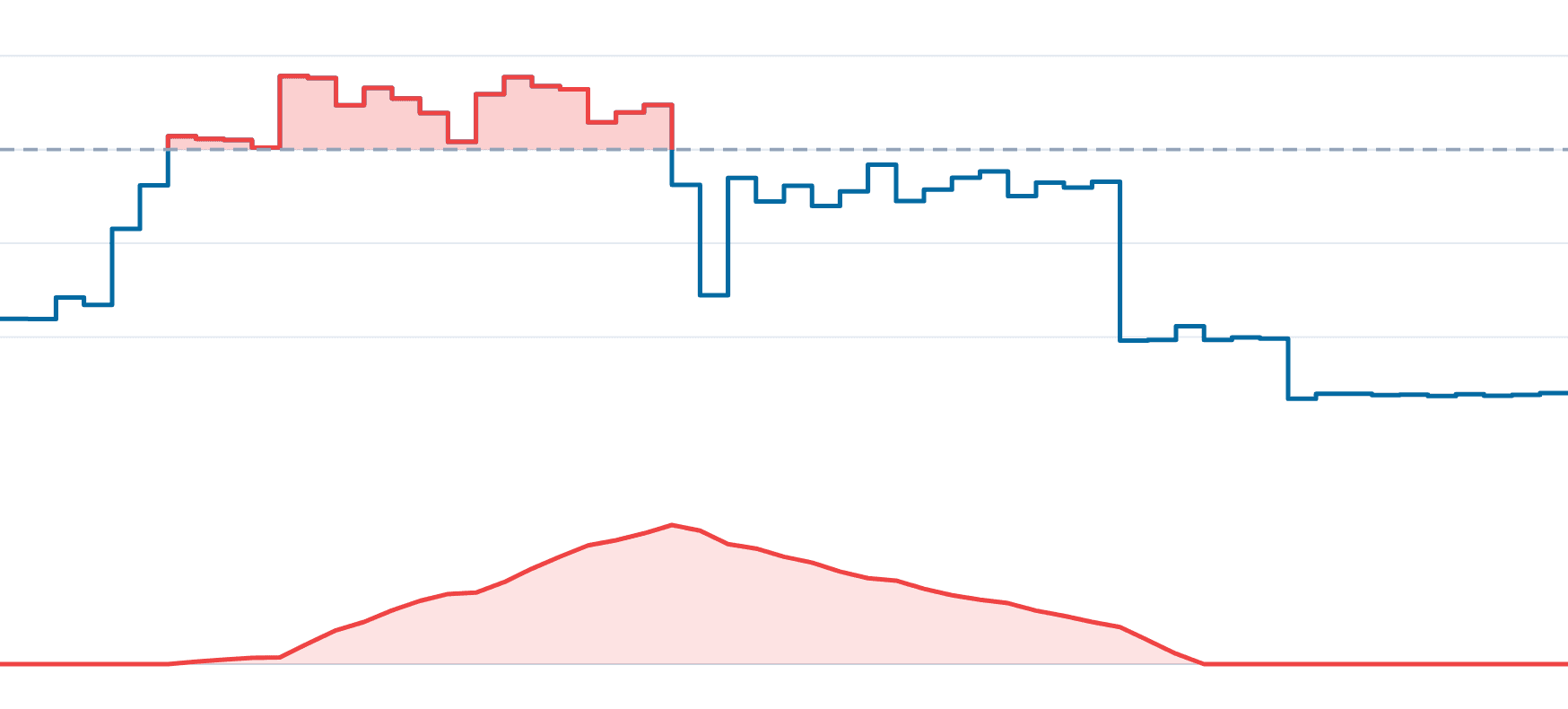
The capacity. The most energy above the limit falls on Tuesday 21 January. It is cold, the heat pump is still running at full power when production starts, and at 8:30 the oven switches on. From 7:30 to 12:00, consumption stays above 300 kW, eighteen quarter hours in a row.
The shortfall builds up to 198 kWh before the battery can recharge
Consumption per quarter hour on 21 January between 6:00 and 20:00. From 7:30 to 12:00 it is above the 300 kW contracted transport capacity. Over that time the accumulated shortfall rises to 198 kWh, and it is back to zero by 16:45.
Each quarter hour adds a quarter of the exceedance, because 1 kW for a quarter hour is 0.25 kWh. The first one, at 7:30, is 14.3 kW above the limit and so adds 3.6 kWh. That is how the shortfall builds up to 198 kWh by 12:00. Because no quarter hour in between drops below the limit, the battery cannot recharge along the way and has to deliver all 198 kWh in one go. With the discharge losses that is 198 / 0.92 = 215 kWh out of the battery, and with the charge limits 215 / 0.9 = 239 kWh of capacity.
After 12:00 the battery recharges. During the lunch break there is plenty of room under the limit, in the afternoon still 15 to 60 kW. By a quarter to five it is full again, well in time for the next morning.
The result is a battery of 90 kW and 239 kWh, about 2.7 kWh per kW. Wattix arrives at 89.6 kW and 238.7 kWh with the same inputs. In practice you then choose the next size up that is available.

“Our clients want to grow. Extra warehouses, machines, production lines. But they can't get additional capacity from the grid operator. Wattix helps us show what's still possible within their existing connection.”
What rules of thumb make of this company
Several rules of thumb for sizing a business battery can be found online. They are quick, and for a first estimate without metering data they are not unreasonable. A common one is that the capacity is about 1 to 1.5 times the power1, or a battery of 0.5C to 1C, which comes down to 1 to 2 times the power2. Another multiplies the average exceedance by the average duration of a peak and divides by 0.8 for the depth of discharge2. And some guides prefer to analyse the profile per hour3.
For each battery below, the whole year was recalculated: on how many days does consumption still go over 300 kW?
| Method | Battery | Days still above 300 kW | Largest exceedance remaining |
|---|---|---|---|
| Calculated quarter hour by quarter hour | 90 kW / 239 kWh | 0 | 0 kW |
| Capacity is 2 times the power | 90 kW / 179 kWh | 2 | 64 kW |
| Capacity is 1.5 times the power | 90 kW / 134 kWh | 5 | 77 kW |
| Average exceedance times average duration, divided by 0.8 | 90 kW / 20 kWh | 48 | 88 kW |
| Quarter hour by quarter hour, but on hourly data | 66 kW / 231 kWh | 13 | 24 kW |
Two things stand out.
- Too small does not mean shaving a little less. As soon as the battery is empty, the rest of the peak gets through in full. With 1.5 times the power, an exceedance of 77 kW remains, almost as much as the 90 kW without a battery.
- Averages are the wrong starting point. An average exceedance in this profile lasts 37 minutes and reaches up to 26 kW above the limit. A battery that can handle that gets through an average day. But the size is set by the heaviest day, and on that day the exceedance lasts four and a half hours, more than seven times as long.
For this company, every rule of thumb comes out too small. It can go the other way too: with short, sharp peaks, 2 times the power buys kilowatt hours that never get used. A fixed ratio does not know the profile.
Why quarter-hour data and not hourly data
The grid operator looks at the quarter hour. Look at an hour instead, and a peak lasting one quarter hour is spread over four. On 16 December the highest peak in the hourly average looks like 352 kW, while the highest quarter hour was 390 kW.
In hourly data the highest peak comes out 38 kW lower
Consumption on 16 December per quarter hour and as an hourly average, between 6:00 and 20:00. The highest quarter hour is 390 kW, at 10:45. The highest hourly average is 352 kW, from 11:00 to 12:00. The contracted transport capacity is 300 kW.
Over the whole year, the same calculation on hourly data gives 66 kW instead of 90 kW: more than a quarter too little power. The capacity comes out almost right at 231 kWh, because an hourly average does not change the amount of energy. The power is the problem: with 66 kW, consumption still goes over the limit on thirteen days.
A few days set the size of the battery
Calculated per month, the full 239 kWh is only needed in January, and 219 kWh in December. In eight of the twelve months, less than 100 kWh is enough. Size on a few summer months of data and you end up with less than half.
Only January and December need more than 200 kWh
Capacity needed when each month is calculated on its own, in kWh
| January | 239 kWh |
|---|---|
| February | 72 kWh |
| March | 129 kWh |
| April | 46 kWh |
| May | 85 kWh |
| June | 42 kWh |
| July | 86 kWh |
| August | 20 kWh |
| September | 101 kWh |
| October | 51 kWh |
| November | 84 kWh |
| December | 219 kWh |
The reverse is also true: the last kilowatt hours are bought for a handful of days a year. A battery with 80% of the calculated capacity, 191 kWh, leaves two days with an exceedance, with a peak of up to 48 kW above the limit. Accepting that exceedance is not an option. In a congestion area you may not exceed the contracted transport capacity, and there is no fine to buy it off with4. A company that exceeds it anyway gets an email and a phone call5, has to take measures within four weeks, and after the next exceedance is in default and liable for the damage6. As a last resort, the grid operator can disconnect it5. So a smaller battery only works with a plan for those two days, such as switching the oven on later or turning the heat pump down. That trade-off is the client's to make, and it is easiest with both scenarios side by side. More on the situation behind the meter under grid congestion.
What Wattix does here
In Wattix you switch on automatic sizing for a battery. The software then calculates the whole period of your data per quarter hour and finds, in a single optimisation, the smallest battery that stays within the contracted transport capacity, along the same lines as the four steps above. Power and capacity follow independently from the profile, with the efficiency and charge limits you set yourself, and energy prices play no part in the sizing. How that works is explained under automatic battery sizing in Wattix.
Then the actual advice begins: comparing scenarios side by side. With and without a battery, a smaller battery with a plan for the heaviest days, or a battery that also stores solar power or trades on energy prices. See battery storage behind the meter. What else a simulation calculates, and how accurate it is, is covered in what an energy simulation is.

“Clients respond enthusiastically, and the best part is: they understand it. They get why you're doing or not doing something. That's what I find most important.”
Frequently asked questions about sizing a battery
How many kWh do you need per kW of battery power?
There is no fixed ratio. Power and capacity both follow from the load profile, and often from different days. In the worked example it is 239 kWh at 90 kW, almost three hours. With 1.5 times the power, five days with an exceedance remained.
Can I size a battery with hourly data?
You can, but the power comes out too low. A peak lasting one quarter hour is spread over four quarter hours in the hourly average. In the worked example, hourly data gave 66 kW instead of 90 kW, and consumption still went over the limit on thirteen days.
How much margin do you add for efficiency and depth of discharge?
Calculate them separately instead of adding a fixed percentage. With a round-trip efficiency of 85%, you lose about 8% when discharging. If you charge between 10% and 100%, 90% of the capacity is usable. Together that makes the battery in the worked example just over 20% larger than the energy above the limit.
What if the peaks fall on several days in a row?
Then what matters is whether the battery can recharge between the peaks. It only recharges with the room left under the contracted transport capacity. If that room is too small between the peaks, the shortfall builds up over several days and the battery has to be larger. That is why you calculate quarter hour by quarter hour, not per day.
How much metering data do you need to size a battery?
A full year of quarter-hour data. The size is set by a few heavy days, and those often fall in winter. In the worked example, one day in January and one in December set the size. With data from April to September only, the capacity would have come out at less than half.
Can the battery be smaller if you accept a few exceedances?
Accepting an exceedance is not an option. In a congestion area, exceeding the contracted transport capacity is not allowed, and there is no fine to buy it off with: the grid operator emails, calls and, as a last resort, can disconnect. A smaller battery can work if you handle the remaining days another way. In the worked example, 80% of the calculated capacity leaves two days, with a peak of up to 48 kW above the limit. Calculate that as a separate scenario, for example with the oven switched on later on those days.
Should you allow for growth when sizing?
Yes, but not with a fixed percentage. Draw the expansion, such as a new machine or charge points, as a profile on top of the measured consumption and size again. Then you see whether the growth mainly needs more power or more capacity.
Related pages
- Automatic battery sizing for peak shavingAutomatically calculate the power and capacity needed to stay within your contracted capacity.
- Behind-the-meter battery storageSize storage for peak shaving and for using more of the energy you generate.
- Grid congestionFind the peak moments and show what is still possible without a grid upgrade.
The grid is full.
Show what still fits.
In a demo you see how to get from metering data to a recommendation you can back up. Bring your own data and we look at your case right away.
Sources
-
Uw Groene Stroom, Peakshaving met batterij (in Dutch), gives a capacity of 1 to 1.5 times the power as a guideline. ↩
-
Navetto, Peak shaving batterij: dimensionering en EMS (in Dutch): the capacity in kWh follows from the average excess peak in kW multiplied by the average peak duration in hours, with a depth of discharge of 80%, and LFP systems usually run at 0.5C to 1C continuously. ↩ ↩2
-
Energy Shift, Hoe bepaalt u de juiste batterijcapaciteit voor uw bedrijf? (in Dutch): "bij voorkeur op uurbasis", preferably per hour. ↩
-
Netbeheer Nederland, Codewijzigingsvoorstel transportgrenswaarden (in Dutch), 22 June 2026, p. 5: exceeding the contracted transport capacity in a congestion area "heeft op dit moment geen directe financiële consequentie voor de aangeslotene", has no direct financial consequence at the moment, although it is not allowed. Outside congestion areas the contracted capacity is raised after an exceedance, sometimes retroactively for the whole year. The grid operators propose to attach a financial consequence in congestion areas too. ↩
-
Enexis, Gecontracteerd transportvermogen overschrijden (in Dutch): "Dan krijgt u een e-mail van ons en bellen we u", you get an email and a call, and as a last resort disconnection or legal steps. ↩ ↩2
-
Liander, Vermogen overschreden (in Dutch): after a first exceedance, the customer has to take measures "uiterlijk binnen vier weken", within four weeks; after the next, the customer is in default. This applies in congestion areas. ↩