Smart charging: show how many charge points do fit
A business wants charge points, but its grid connection cannot grow. With Wattix you simulate smart charging per quarter hour and see for every charging session how much energy each car gets, within the contracted capacity.
“How many charge points can we add?”
Every business that goes electric asks it. For a long time a fixed simultaneity factor was a fine answer: while the connection had room to spare, a miscalculation disappeared in the margin. Now that the room is gone, the answer has to hold per quarter hour and per car.
| Fixed simultaneity factor | Supplier’s calculator | Wattix | |
|---|---|---|---|
| Calculates with the site’s consumption, per quarter hour | No | Depends on the tool | Yes |
| Shows per car whether it is full when it leaves | No | Depends on the tool | Yes |
| Takes solar power and energy prices into account | No | Depends on the tool | Yes |
| Independent of a charger or charge management brand | Yes | No | Yes |
| An answer within minutes | Yes | Yes | Yes |

“With some providers you have to use their EMS and trust their simulation. We want to choose the best EMS per project. Wattix gives us that freedom.”
One day, calculated three times
A business site with 220 kW of contracted capacity, solar panels on the roof, 14 staff cars and 8 delivery vans. The same charging sessions, three ways of charging.
Every car charges straight away, at full power
Around half past eight the staff cars arrive, at five the delivery vans. Without control they all start charging at once, and the connection peaks at 273 kW: far above the contracted 220 kW. A simultaneity factor does not show this, because it averages out exactly these peaks.
Within the connection, but right at the edge
Load balancing distributes the power across the charge points, so the 220 kW is never exceeded. Every car is still full when it leaves. But the vans charge as early as they can, and in the evening the connection sits at its limit for three hours, when power is most expensive.
On solar power and overnight
Smart charging also looks at when charging is cheapest. The staff cars charge around midday, when the solar panels cover much of the site’s demand and power is cheap. The vans charge overnight. The same sessions, every car full, and the evening peak is gone.
From charging sessions to well-founded advice
With Wattix you simulate smart charging per quarter hour. You define the charging sessions for each charge point, Wattix schedules the charging within the contracted capacity, on solar power and at the cheapest moments, and you see for every session how much energy the car gets. So you show your client how many charge points fit.
- Step 1
Define the charging sessions
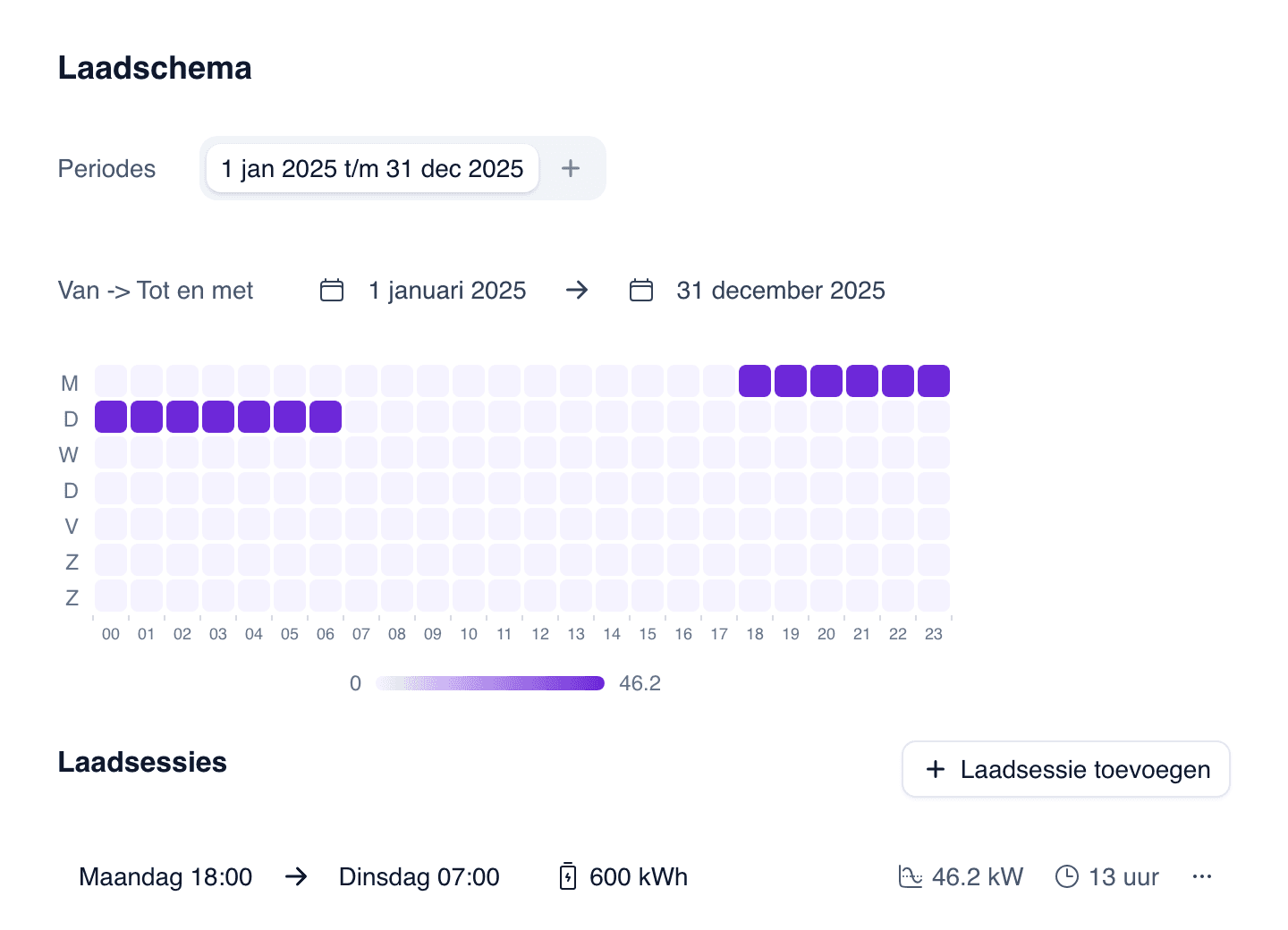
For each charge point its power and the weekly sessions: when the car arrives, when it leaves and how many kWh it needs. For holidays or seasons you set a different weekly pattern.
- Step 2
Wattix schedules the charging
Within the time the car is plugged in and within the contracted capacity. Within that limit on solar power and in the cheapest quarter hours, with a battery if there is one. A schedule with known prices, not real-time control.
- Step 3
See per session what fits
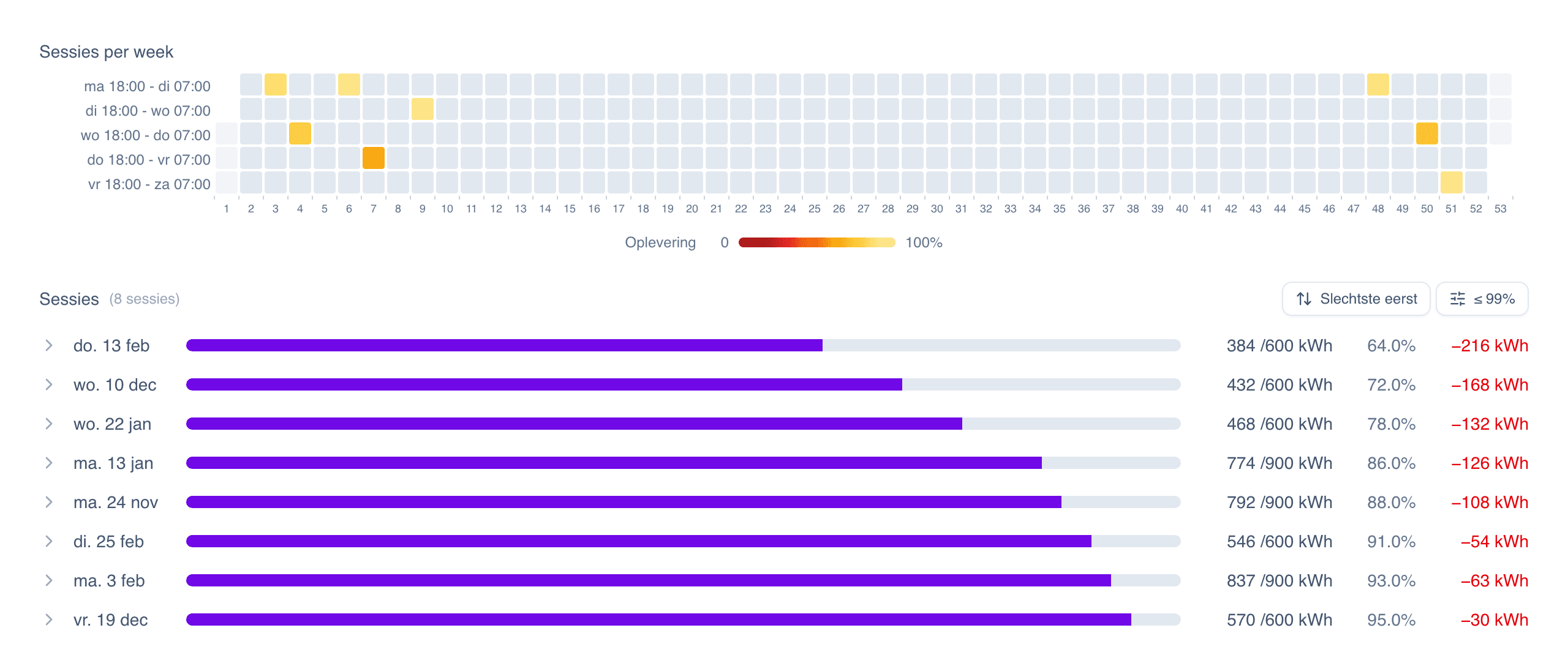
For each session the energy required and delivered, and where it gets tight the shortfall in kWh. Compare scenarios with more or fewer charge points, with or without a battery, and let your client choose.
Frequently asked questions about smart charging
What is smart charging?
With smart charging, charging power is spread over time instead of every car charging at full power straight away. The charge points stay within the connection together, and cars charge on solar power or at cheap moments where possible. With Wattix you calculate in advance what that means for a site.
What is the difference between smart charging and load balancing?
Load balancing distributes the available power across charge points so the connection is not exceeded. Smart charging goes further and also chooses when to charge, for example when the sun shines or prices are low. Wattix calculates both in a single optimisation.
Which simultaneity factor should you use for charge points?
In Wattix, none. Simultaneity follows from the charging sessions themselves: when cars arrive, leave and how much energy they need. So you see not only whether the connection can cope, but also which sessions fall short when capacity is tight.
How much power is available for a charging hub?
Whatever is left of the contracted capacity per quarter hour next to the other consumption, plus what solar panels or a battery supply at that moment. That room differs every quarter hour, which is why Wattix uses the connection’s quarter-hour data rather than a single number.
What happens if not every car can be fully charged?
Wattix stays within the connection and a car gets less energy. You see that shortfall per session in kWh and as a share of what was needed. So you know in advance whether a number of charge points is workable, and which sessions get tight.
Can smart charging be combined with solar panels and a battery?
Yes. Solar power comes before grid power when charging, and a battery can top up the cars. Wattix also prevents the battery from charging from the grid only to charge a car afterwards. So you compare a charging hub with and without a battery in the same scenario.
What data do you need to get started?
The contracted capacity, the power of the charge points and a picture of the charging sessions: arrival, departure and energy needed per week. For the rest of the site you work with the connection’s quarter-hour data, or with a profile if there is none yet.
The grid is full.
Show what still fits.
In a demo you see how to get from metering data to a recommendation you can back up. Bring your own data and we look at your case right away.
Related pages
- EV charging infrastructureCalculate how many charge points fit within the connection and what smart charging or storage unlocks.
- Wattix for installersSize systems in minutes and work through scenarios live with your client.
- Wattix for energy consultantsBack up your advice with transparent assumptions and scenarios side by side.