Help businesses take their next step in the energy transition
With Wattix, you work out for each business what solar panels, a battery or charge points do within its current grid connection. In 15-minute steps, from its own meter data and independent of suppliers.
How to model a business in Wattix
A business owner wants to know whether solar panels, a battery or charge points fit, often with a grid connection that is already full. Good advice starts with the 15-minute consumption of that one business. Wattix models the scenarios independently of any supplier and shows the assumptions the advice rests on.
- What you enter
- The business's 15-minute meter data, or a profile from the Data Studio where there is no meter data yet, as with new buildings. You also enter the business's grid connection and energy contract, and the assets you want to examine: solar panels, batteries, charge points and generators.
- What Wattix calculates
- Wattix calculates the business's energy flows in 15-minute steps. Battery dispatch is optimized for the lowest cost within the limits of the connection. Every calculation uses the same method and gives the same outcome for the same input.
- What comes out
- For each scenario: the peaks, the days on which the business exceeds its connection's limit, import and export, self-sufficiency and energy costs. With the comparison and the report, the business owner sees which step fits, and why.
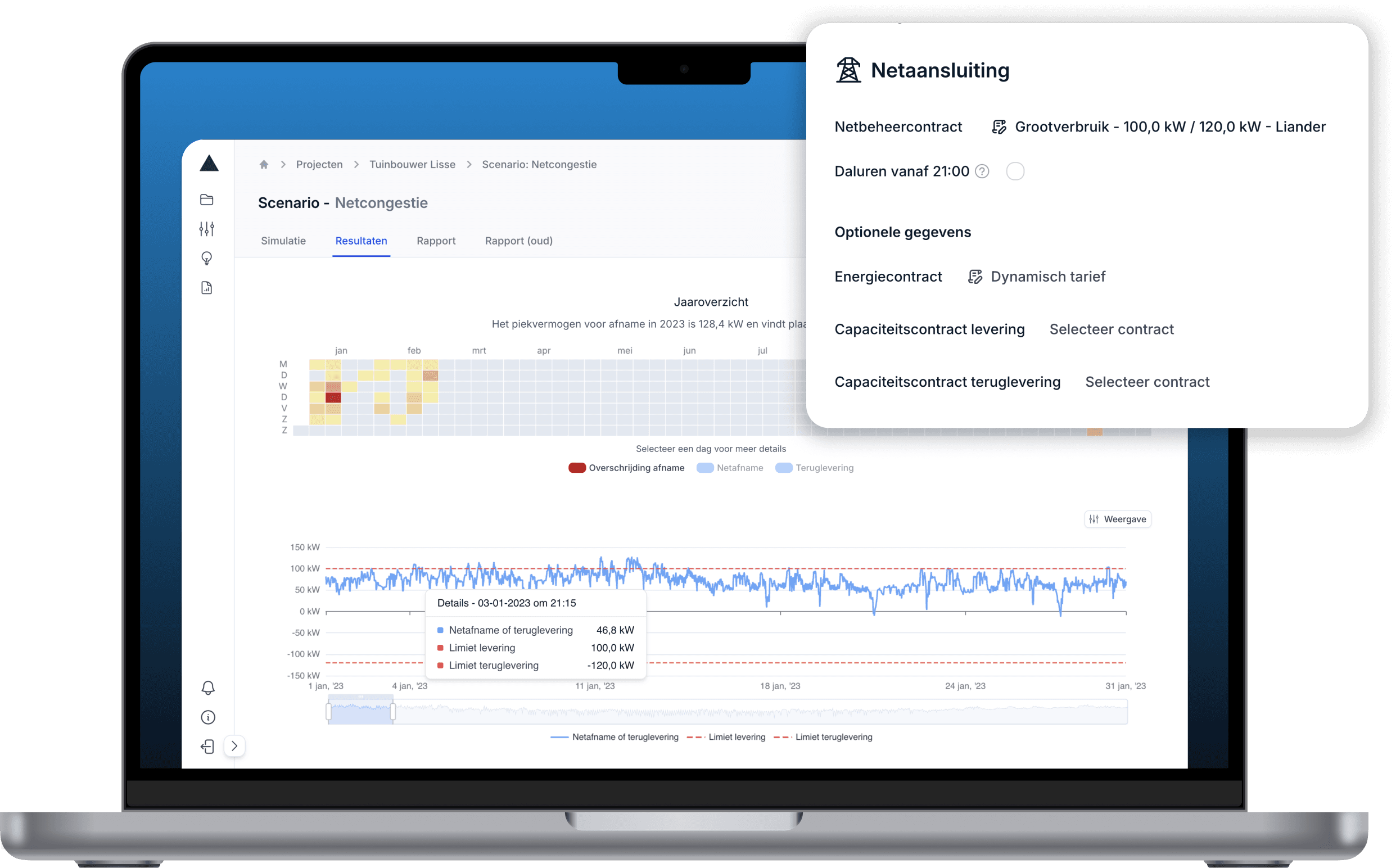
Map a business's situation
Advice on solar, storage or charge points starts with two questions: when does the business use energy, and how much room does its connection leave for it?
Load the business's 15-minute data. An annual total hides the peaks that matter.
Where there is no meter data yet, as with new buildings, you create a profile in the Data Studio.
Check consumption against the business's connection, for both import and export, to see when it gets tight.
Test what solar, storage and EV charging change
In each scenario, add the assets the business owner is considering. Wattix models them together with the business's consumption, within the limits of the connection.
Simulate rooftop generation and see how much the business uses itself, how much it exports and whether the connection can handle it.
Add a battery and see which peaks it flattens. Wattix dispatches it for the lowest cost within the limits of the connection.
Work out how many charge points fit and what smart charging does to the business's peak.
Give the business owner a well-founded next step
A municipality gives independent advice. Wattix calculates without a preference for any supplier or product, and every outcome can be traced.
Compare the business with and without solar, storage or charge points, and see which combination fits within the connection.
Record the scenarios, the inputs and the outcomes in a report the business owner takes to an installer.
Every advisor uses the same method, so every business in your municipality gets advice on the same basis.
For a group of businesses too
Are the businesses on a business park considering a shared connection? It works like a shared car park: not everyone is there at once. Wattix models the businesses at a high level as loads behind one connection.
Businesses don't all peak at the same moment. Wattix adds up the profiles quarter hour by quarter hour, so you see the group's peak instead of the sum of separate peaks.
Place solar panels, a battery or charge points behind the shared connection and see what they change for the group.
You see what the group needs from the grid together. Wattix does not model how that demand splits across separate connections, nor a group transport agreement.
What you see for each scenario
The outcomes you discuss with the business owner, for every scenario you model.
The business's highest import and export, and when they occur.
On how many days the business exceeds its connection's limit, shown day by day in the annual calendar.
How much energy the business draws from and feeds back into the grid, in 15-minute steps.
The share of consumption the business covers with its own generation and storage.
When the battery charges and discharges, optimized for the lowest cost within the connection.
The business's energy costs, with the prices and tariffs of the contract you choose.
What our customers say

“We don't just create one analysis, but one for each phase of the customer's growth path. That way we're already advising them on what to install now to be significantly cheaper by 2035.”

“The simulations we received through intermediaries always felt commercially driven. We provide technical, substantive advice based on the client's situation, not based on our own commercial interest. That's why we wanted our own simulation tool and found what we were looking for in Wattix.”

“Our clients want to grow. Extra warehouses, machines, production lines. But they can't get additional capacity from the grid operator. Wattix helps us show what's still possible within their existing connection.”
Frequently asked questions about energy advice to businesses
What data do you need from a business?
The business's 15-minute meter data, or a profile from the Data Studio where there is no meter data yet, as with new buildings. You also need the details of the grid connection and the energy contract, and the assets the business owner is considering.
What if the business's grid connection is already full?
Then Wattix shows what fits within the current connection. You see when consumption exceeds the limit, and what a battery or smart charging changes about it. That shows whether a step is possible without waiting for a larger connection.
Why does Wattix calculate in 15-minute steps?
Because a connection gets tight at particular moments, not over a whole year. An annual total shows how much energy a business uses, but not when. Only 15-minute data shows whether a peak coincides with solar generation or with cars charging.
Can Wattix model an energy hub?
At a high level. Wattix places the businesses in the hub, with their solar panels, batteries and charge points, behind one shared connection and models it in 15-minute steps. You see what the group as a whole needs from the grid. Wattix does not model how that demand splits across separate connections, nor a group transport agreement.
Does Wattix also calculate the payback period of an investment?
No. Wattix works out the business's energy costs for each scenario, with the prices and tariffs of the contract you choose. Investment costs and payback are not part of it. The difference in energy costs between two scenarios is the saving. Set the investment against it and you can work out the payback period yourself.
Related pages
- Behind-the-meter battery storageSize storage for peak shaving and for using more of the energy you generate.
- EV charging infrastructureCalculate EV charging per quarter hour within the connection, and see what smart charging or storage unlocks.
- Grid congestionFind the peak moments and show what is still possible without a grid upgrade.
The grid is full.
Show what still fits.
In a demo you see how to get from metering data to a recommendation you can back up. Bring your own data and we look at your case right away.